A thyroid nodule is not automatically cancer, and its size alone does not decide whether you need surgery. By the end, you will know which warning signs need prompt assessment, how ultrasound and biopsy results guide decisions, when observation is safer, and what to compare when choosing thyroid care in Pune.
Key takeaways
- Most thyroid nodules are benign; ultrasound features matter more than size alone.
- TSH, ultrasound and fine-needle aspiration guide observation, surgery or further testing.
- Observation is appropriate when tests show low-risk features and thyroid function remains stable.
- Compare surgeon experience, hospital facilities, pathology services and the complete treatment estimate.
What a thyroid nodule can mean—and when it needs prompt assessment
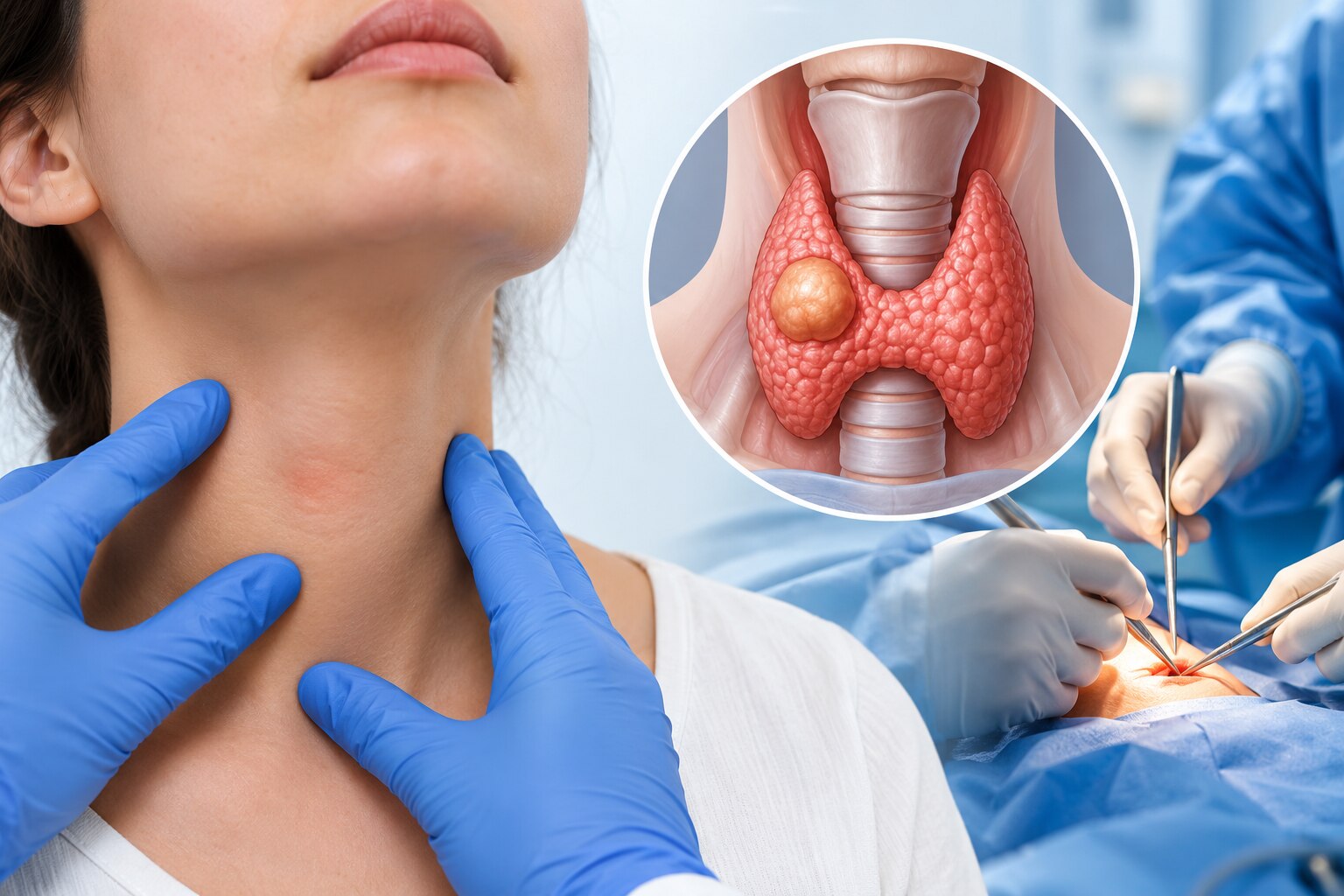
A thyroid nodule is a lump within the thyroid gland. Roughly 90–95% are benign, and size alone does not establish thyroid cancer risk. Ultrasound appearance, thyroid function, lymph nodes and biopsy results provide the meaningful evidence.
The main patterns include:
- Solitary nodule: one distinct lump in an otherwise uniform gland.
- Multinodular goitre: several nodules enlarging the thyroid; a person assessing multinodular goitre in Pune still needs each significant nodule assessed on ultrasound.
- Cystic nodule: a lump containing fluid, either entirely or partly.
- Thyroiditis: inflammation that can cause tenderness, diffuse enlargement or nodule-like areas.
- Hot nodule: a nodule producing excess thyroid hormone on a radionuclide scan; it is rarely malignant.
- Cold nodule: a nodule that does not take up tracer. Cold does not mean cancerous; most cold nodules are also benign.
Arrange prompt clinical assessment if you notice:
- Rapid enlargement
- New hoarseness
- Difficulty swallowing or breathing
- A mass that feels fixed rather than mobile
- Enlarged neck lymph nodes
- Childhood neck radiation
- A family history of thyroid cancer
These findings raise concern for compression, invasive disease or another diagnosis, but they do not prove malignancy. A benign thyroid nodule can still cause pressure symptoms, while a cancerous nodule can initially cause none.
How ultrasound, TSH and fine-needle aspiration determine the next step
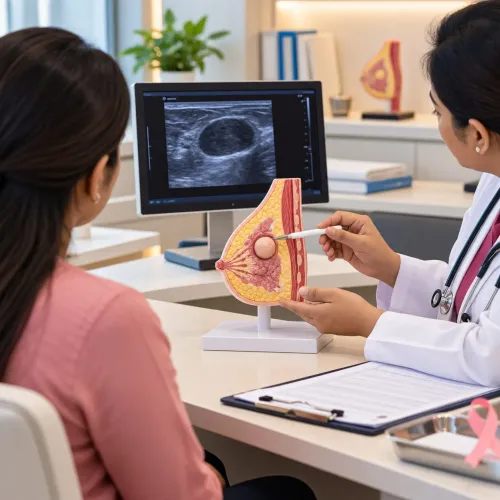
A neck examination, TSH test, thyroid ultrasound and review of cervical lymph nodes usually determine the next step.
1. A clinician checks the thyroid for size, firmness, movement and fixation, then feels for enlarged neck lymph nodes. Serum TSH shows whether the gland is underactive, normal or overactive.
2. If TSH is low, a radionuclide thyroid scan can identify a hyperfunctioning “hot” nodule. Hot nodules are rarely malignant and usually do not need FNA solely because they produce thyroid hormone.
3. A thyroid ultrasound assesses composition, margins, shape and calcification. Microcalcifications, irregular margins, a taller-than-wide shape and abnormal lymph nodes raise concern and can lower the biopsy threshold.
ATA and ACR TI-RADS use different thresholds:
| System | Typical FNA threshold |
|---|---|
| ATA | About 1 cm for high or intermediate suspicion, 1.5 cm for low suspicion, and 2 cm for very-low suspicion; purely cystic nodules usually need no diagnostic FNA |
| ACR TI-RADS | 2.5 cm for TR3, 1.5 cm for TR4, and 1 cm for TR5 |
4. During ultrasound-guided FNA, a fine needle collects cells through the skin. Expect a brief needle prick followed by pressure; the procedure usually takes minutes. Cytology is reported as Bethesda benign, nondiagnostic, indeterminate Bethesda III or IV, suspicious or malignant. A nondiagnostic result is not benign: repeat FNA is standard.
Selected indeterminate nodules may undergo molecular testing, surveillance or diagnostic lobectomy; surgery is not automatic.
When observation is safer than thyroid surgery
A small, benign-appearing nodule without pain, pressure or voice change is often safer to observe than to remove immediately. Thyroid nodule surveillance avoids an operation for a lesion that may never cause harm.
The follow-up interval depends on ultrasound risk and the biopsy result. A repeat thyroid ultrasound in about 6–24 months is used when indicated, with longer or no routine imaging for some stable, very-low-risk nodules. Meaningful growth, new suspicious features or symptoms can lead to repeat FNA or surgery.
Surgery becomes more reasonable when you have:
- Confirmed or strongly suspected cancer
- Substantial growth or new high-risk ultrasound features
- Compressive symptoms, such as trouble swallowing or breathing
- A toxic nodule or toxic goitre causing hyperthyroidism; toxic thyroid nodule surgery is one treatment option after endocrine assessment
- Bethesda III IV cytology that remains concerning after repeat FNA, molecular testing or specialist review
- A large cyst or a cyst causing pain, pressure or repeated recurrence
Unnecessary surgery carries real costs: recurrent-laryngeal-nerve injury causing voice change, low calcium from parathyroid injury, bleeding, a neck scar and dependence on thyroid hormone after total removal. Ask an endocrinologist to assess thyroiditis or hyperthyroidism first.
Complex indeterminate results deserve endocrine and thyroid-pathology input, while suspected advanced cancer should involve an oncology and high-volume thyroid-surgery team before choosing an operation.
How to choose the operation, surgeon and hospital in Pune
Choose the operation that matches the cancer’s extent, not the most advertised technique. For selected differentiated cancers confined to one lobe, particularly tumours up to 4 cm without gross extension or clinically apparent lymph-node spread, lobectomy can be adequate.
Total thyroidectomy is considered for disease in both lobes, spread, larger or higher-risk tumours, and individual factors.
| Option | Main trade-off | When it applies |
|---|---|---|
| Lobectomy | Lower permanent hypocalcaemia risk; some thyroid function remains | One-lobe, lower-risk disease |
| Total thyroidectomy | Removes all thyroid tissue; lifelong levothyroxine is normally required | Bilateral, spread, larger or higher-risk disease |
| Open thyroidectomy | Direct, established neck access with a scar | Most operations |
| Endoscopic, remote-access or robotic thyroid surgery | Selected access routes with different scars and risks | Suitable anatomy and disease; not routine laparoscopic abdominal surgery |
Some lobectomy patients still need hormone replacement. Endoscopic, remote-access and robotic thyroid surgery can be unsuitable with tumour invasion, lymph-node disease, unusual anatomy, previous operations or safety concerns.
Before choosing thyroid surgery Pune patients should ask:
- How many thyroid operations do you perform each year, and what are your voice-nerve and permanent calcium complication rates?
- Do you use recurrent laryngeal nerve monitoring, and do I need preoperative voice or laryngeal assessment?
- Who reviews the pathology, and when will calcium testing occur?
- Does the hospital have intensive-care backup, anaesthesia cover and emergency support?
Dr Mahesh B Jadhav can be one clinician you evaluate alongside other surgeons using these questions, rather than marketing claims.
What preparation, recovery, pathology and total cost involve
Bring your ultrasound, radionuclide scan, FNA report and any prior pathology slides or reports. The surgical team must review anticoagulants, diabetes medicines and supplements, and correct uncontrolled hyperthyroidism or hypothyroidism before anaesthesia. Ask whether laryngeal examination is needed, especially with hoarseness, previous neck surgery or suspected invasive disease.
Thyroidectomy uses general anaesthesia. Choose a facility with on-site pathology, an anaesthesia team, intensive-care backup and postoperative calcium testing.
| Admission | What to expect | Practical issue |
|---|---|---|
| Day case | Discharge after observation | Suitable only when pain, calcium risk and home support are acceptable |
| Overnight | Monitoring through the first night | Useful when calcium checks, drains, medical conditions or distance from hospital require it |
During thyroidectomy recovery, keep the wound clean and follow dressing instructions. Neck tightness, mild swelling and pain are expected; avoid strenuous activity until advised. Drive only when you can turn your neck safely and have stopped sedating medicines.
Desk work may resume sooner than lifting or heavy work, which depends on recovery and the surgeon’s advice.
Discuss thyroid surgery complications: neck bleeding, infection, scar concerns, recurrent-laryngeal-nerve injury with voice change, and low calcium after parathyroid injury. Final pathology determines surveillance, completion thyroidectomy, selective radioactive iodine and endocrinology follow-up.
Ask for an itemised thyroid surgery cost Pune estimate covering consultation, ultrasound, biopsy, pathology, anaesthesia, operating-room charges, admission, medicines, calcium or hormone tests and follow-up visits.
Frequently asked questions
When does a thyroid nodule need prompt assessment?
Arrange prompt medical assessment for a new or enlarging lump, hoarseness, difficulty swallowing or breathing, neck lymph nodes, or ultrasound features that raise cancer concern. Size alone does not determine cancer risk.
How do ultrasound, TSH and fine-needle aspiration guide treatment?
TSH shows whether the thyroid is overactive or underactive. Ultrasound assesses the nodule’s composition, margins, calcifications, shape, blood flow and nearby lymph nodes. Fine-needle aspiration collects cells for laboratory examination when the ultrasound pattern and size meet biopsy criteria.
When is observation safer than thyroid surgery?
Observation is appropriate when ultrasound and biopsy findings indicate low risk, the nodule causes no significant pressure symptoms, and thyroid function is stable. Follow-up usually includes repeat clinical assessment and ultrasound at an interval chosen by your clinician.
What should you compare when choosing thyroid surgery in Pune?
Ask about the proposed operation, the surgeon’s thyroid surgery experience, anaesthesia and hospital facilities, nerve and parathyroid monitoring policies, pathology arrangements, follow-up access and the complete written cost estimate.
What do preparation, recovery, pathology and total cost involve?
Preparation can include blood tests, medication review, ultrasound or biopsy reports and an anaesthesia assessment. Recovery depends on the operation. Pathology confirms the diagnosis after surgery; request the report and discuss its implications. Ask the hospital to separate surgeon, anaesthesia, room, tests, pathology, medicines and follow-up charges.