Laparoscopic Hernia Repair
Laparoscopic Hernia Repair
Laparoscopic hernia repair is a minimally invasive procedure used to treat inguinal, umbilical, ventral, incisional and selected recurrent hernias. Instead of a large incision, the surgeon uses small keyhole incisions to introduce a camera and specialized instruments.
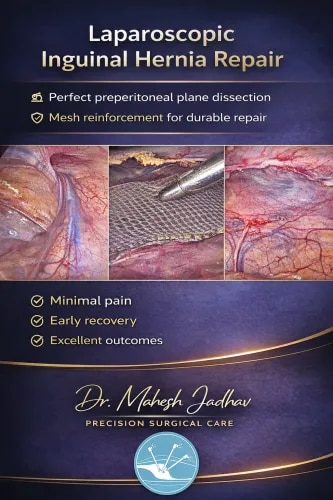
During surgery, the hernia defect is carefully identified and the protruding tissue is returned to its normal position. A surgical mesh is then placed to reinforce the weakened abdominal wall and reduce the risk of recurrence. Depending on the type and location of the hernia, techniques such as TEP, TAPP or laparoscopic ventral/incisional hernia repair may be used.
Benefits
Small incisions and reduced tissue trauma
Less postoperative discomfort in many patients
Faster mobilization and recovery
Earlier return to routine activities
Excellent visualization of the abdominal wall
Particularly useful for bilateral and selected recurrent inguinal hernias
Suitable for selected ventral and incisional hernias
Who May Need Hernia Repair?
Surgery may be recommended when a hernia causes pain, discomfort, progressive enlargement, difficulty with daily activities, or has a risk of becoming incarcerated or strangulated. The ideal approach depends on the hernia size and location, previous surgeries, previous mesh repairs, general health and individual anatomy.
Recovery
Most patients are encouraged to walk soon after surgery. Mild pain, swelling, bruising or a pulling sensation can occur and usually improves gradually. Return to work and exercise depends on the type of repair and individual recovery. Heavy lifting should be resumed only as advised by the surgeon.
Risks
Although generally safe, hernia surgery can have complications such as bleeding, infection, seroma, urinary retention, injury to surrounding structures, mesh-related complications, chronic pain and recurrence.
A detailed consultation helps determine whether laparoscopic, open or another minimally invasive technique is most appropriate.
Book a consultation for personalized evaluation and treatment of your hernia.