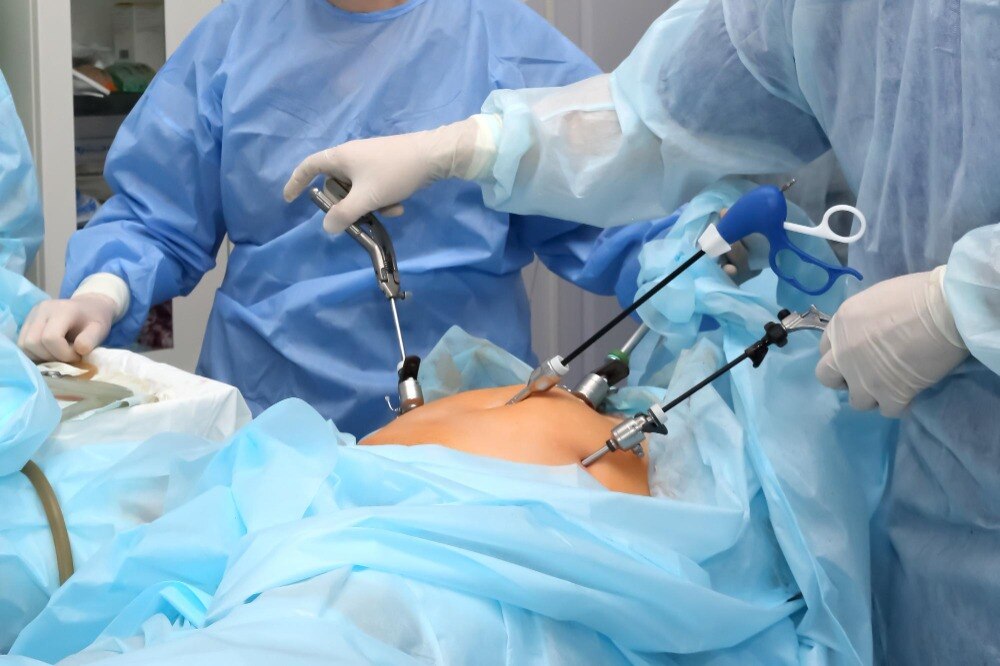
The choice between laparoscopic appendectomy, robotic treatment and open surgery depends less on which technology sounds newer than on the severity of appendicitis, your anatomy and the hospital’s emergency capabilities. You will be able to recognise warning signs, understand the diagnostic and treatment pathway, compare the two minimally invasive approaches and ask whether a Pune or PCMC hospital can safely provide the operation you need.
Key takeaways
- Seek emergency care for worsening right-sided pain, guarding, vomiting or dehydration.
- Ask how imaging and examination indicate uncomplicated or perforated appendicitis.
- Choose laparoscopic, robotic or open surgery based on findings, not marketing.
- Confirm surgeon availability, emergency cover, ICU access and total hospital charges.
When right-sided abdominal pain needs emergency assessment
Worsening abdominal pain that moves toward the right lower abdomen needs emergency assessment, not a routine consultation. Fever, vomiting, loss of appetite, abdominal guarding or rigidity, or inability to keep fluids down increases concern for appendicitis, perforation or dehydration.
Go to an emergency department immediately if you have:
- Fainting, confusion, collapse, breathing difficulty or severe weakness
- High fever, persistent vomiting or signs of severe illness
- Pregnancy, or the patient is a very young child or an older adult
- Pain so severe that you cannot travel safely without assistance
In Pune or PCMC, choose a hospital with round-the-clock anaesthesia, ultrasound or CT imaging, emergency laparoscopy, postoperative monitoring and intensive-care escalation. These capabilities matter when sepsis, perforation or a spreading abdominal infection develops. Call emergency services for collapse, breathing difficulty, confusion or inability to reach hospital safely.
Appendicitis treatment in Pune is not the same as booking a routine operation. Online advice cannot exclude a perforated appendix, an abscess or sepsis without examination and appropriate testing.
For emergency appendix surgery PCMC patients should seek immediate hospital evaluation, even if pain briefly improves; a temporary reduction in pain can occur after rupture and does not make the situation safe.
How doctors confirm appendicitis and identify a complicated case
After arrival, the clinician takes a pain timeline, asks about fever, vomiting, appetite, bowel or urinary symptoms, medicines and previous operations, then examines for tenderness, guarding, rigidity and a mass. No single finding confirms appendicitis.
Initial tests add evidence rather than replace examination:
- A white-cell count: a normal result does not rule out appendicitis, while an elevated result does not prove it.
- C-reactive protein: a raised level supports inflammation and helps assess severity alongside the examination and other results.
- Urine testing: this can identify infection or blood from a urinary stone that mimics appendicitis.
- A pregnancy test when pregnancy is possible: the result changes imaging and anaesthesia planning.
The scan depends on age, sex, pregnancy status, body habitus and local expertise, not simply on whether you seek appendicitis treatment in Pune.
| Test | Common role | Main limitation |
|---|---|---|
| Ultrasound | First choice for many children and pregnant patients | Bowel gas or body habitus can obscure the appendix |
| Contrast CT of the abdomen and pelvis | Commonly used for non-pregnant adults when uncertainty remains | Uses ionising radiation |
| MRI | Useful when radiation avoidance matters | Availability and speed vary |
Imaging and examination distinguish uncomplicated inflammation from an appendicolith, perforation, appendix mass, localized abscess, diffuse peritonitis or sepsis. Perforation can cause ileus and a longer admission.
Selected CT-confirmed uncomplicated cases can receive antibiotics first, but failure, recurrence and an appendicolith’s higher failure risk require discussion. Surgery remains appropriate when source control is needed; complicated cases need antibiotics tailored to response and local resistance patterns. This distinction matters when comparing appendix surgery in Pune with non-operative care.
Laparoscopic, robotic or open: which operation fits the clinical situation
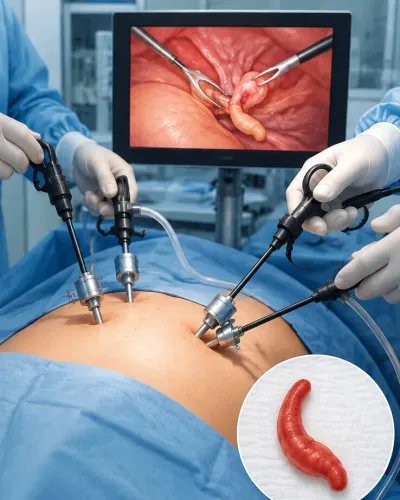
For routine uncomplicated appendicitis, laparoscopic appendectomy is usually the first-line operation. It uses three small incisions: one at the navel for the camera and two lower abdominal ports for instruments. Compared with an open incision, it usually causes less wound pain and fewer wound infections.
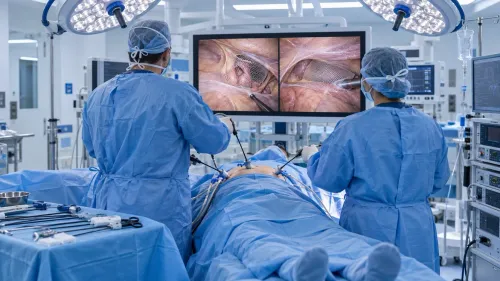
Robotic appendectomy uses separate instrument ports connected to a docked robot, while the surgeon operates from a console. The surgeon directly controls every movement in both operations; the robot does not diagnose, choose actions or operate autonomously.
Robotic treatment has no established clinically important advantage over laparoscopy for routine cases, and docking, equipment, operating-room cost and local experience affect its value.
| Option | Main setup | Situation and trade-off |
|---|---|---|
| Laparoscopic | Three small ports and a camera | Usual choice for uncomplicated appendicitis; less wound morbidity than open surgery |
| Robotic | Ports, robot docking and surgeon console | Feasible in selected complex pelvic, obese or anatomically difficult cases; adds setup and equipment demands |
| Open or converted | One larger incision, or conversion during laparoscopy | Safer when anatomy is unclear, bleeding is uncontrolled, bowel injury occurs or peritonitis is widespread |
Obesity, a difficult pelvis, previous operations, pregnancy and severe inflammation can change the plan. With perforation or an abscess, treatment may require antibiotics, image-guided drainage, washout and appendectomy immediately or later, based on stability and expertise.
Ask these questions when comparing laparoscopic appendix surgery in Pune, laparoscopic appendix surgery or robotic treatment in Pune, or any appendix surgery in Pune: why this approach, what is the conversion plan, and who will manage complications?
What to confirm before choosing a Pune or PCMC hospital
A robotic-surgery service does not prove that the hospital performs robotic appendectomy. Ask whether the named surgeon personally performs it, whether the robot, trained operating-room team and anaesthesia service are available when needed, and whether emergency laparoscopy, CT, pathology, postoperative monitoring and intensive-care escalation run around the clock.
For emergency appendix surgery in PCMC, these capabilities matter more than the word “advanced” in an advertisement.
Before choosing laparoscopic appendix surgery in Pune, ask:
- Does the quote include the surgeon, anaesthetist, operating room, imaging, pathology and antibiotics?
- Are overnight care, drains, conversion to open surgery, complications, intensive care and extra admission days included?
- If the appendix is perforated or sepsis develops, who treats you and where?
- Does the named surgeon offer laparoscopic appendix surgery or robotic treatment in Pune, and who is available overnight?
| Quote item | Confirm before comparing |
|---|---|
| Surgeon and anaesthesia fees | Included separately or in the package |
| Operating room and imaging | CT, theatre and equipment charges covered |
| Pathology, antibiotics and overnight care | Included, capped or billed separately |
| Drain, conversion and complications | Costs if open surgery or drainage becomes necessary |
| Intensive care and extra days | Daily rates and escalation charges |
A package price is not comparable when these items differ. Disclose medicines, allergies, pregnancy possibility and previous operations; follow fasting instructions, and ask the treating team about blood thinners instead of stopping them yourself. Arrange transport home and prepare for an overnight stay if advised.
A consultation with Dr Mahesh B Jadhav can help you obtain these answers, but use the same checklist with any provider.
Recovery expectations and the questions that should guide your decision
After uncomplicated laparoscopic appendectomy, you can often walk and begin light activity relatively soon. Return to work, exercise and driving depends on pain, wound condition, job demands and the operation performed; do not drive while taking sedating pain medicine or when you cannot brake comfortably. Robotic surgery does not guarantee faster recovery.
| Approach | Recovery expectation | What can change it |
|---|---|---|
| Laparoscopic | Light activity often resumes soon | Pain, wound healing and uncomplicated findings |
| Robotic | Recovery may resemble laparoscopy | No proven automatic speed advantage |
| Open or converted surgery | Recovery can take longer | Larger incision, bleeding, inflammation or unsafe anatomy |
Perforation, an abscess, drains, ileus, diffuse peritonitis or prolonged antibiotics can extend admission and recovery regardless of incision type. A low-risk recovery plan for appendix surgery in Pune does not apply to every case, so ask the treating team what your operative findings mean.
Seek prompt medical review for fever, worsening abdominal pain, repeated vomiting, increasing abdominal swelling, pus or spreading wound redness, breathlessness or inability to eat. These symptoms need assessment, not routine recovery advice during appendicitis treatment in Pune.
Before choosing an approach, ask:
- Is the appendix uncomplicated or perforated?
- Is an abscess present?
- Why is robotic surgery being recommended over laparoscopy?
- Who is available overnight if the condition worsens?
- What happens if conversion, drainage or intensive care is required?
Those answers—not the technology label alone—determine the safest fit.
Frequently asked questions
When does right-sided abdominal pain need emergency assessment?
Seek emergency assessment when pain worsens or moves to the right lower abdomen, especially with fever, vomiting, appetite loss, guarding, rigidity or inability to keep fluids down.
How do doctors confirm appendicitis?
Doctors combine your symptoms and abdominal examination with blood tests and imaging such as ultrasound or CT. They also assess for abscess, perforation, obstruction and widespread infection.
Is robotic treatment better than laparoscopic appendix surgery?
Neither approach is automatically better. Laparoscopic surgery suits many cases, while robotic surgery depends on the hospital, surgeon, equipment, cost and the complexity of your condition.
What should you confirm before choosing an appendix surgery hospital in Pune or PCMC?
Confirm emergency access, surgeon availability, anaesthesia support, imaging, operating-room readiness, intensive-care access, pathology services and the complete estimated cost.
What recovery should you expect after appendix surgery?
Recovery depends on whether the appendix has ruptured and which operation you receive. Ask when you can eat, walk, drive, work, bathe, exercise and return for review.
Keywords