Acute appendicitis needs the right level of urgency: some patients need immediate surgery, while others require imaging, antibiotics, drainage or short observation before a final plan. You will learn what happens from emergency assessment through recovery, how treatment changes when the appendix has perforated, and which questions to ask a Pune surgical team.
Key takeaways
- Seek emergency care for worsening right-lower abdominal pain or repeated vomiting.
- Doctors use examination, blood tests and imaging to assess suspected appendicitis.
- Perforation requires faster, more intensive treatment than uncomplicated appendicitis.
- Laparoscopic surgery usually uses smaller incisions; open surgery may suit complex cases.
When abdominal pain needs emergency appendicitis assessment
Go to a Pune hospital emergency department today if abdominal pain is worsening, localising to the right-lower quadrant, or accompanied by repeated vomiting, fever, fainting, confusion, or inability to keep fluids down. Do not wait for a routine appointment if your abdomen becomes rigid, markedly swollen, or painful when touched.
| Finding | Why it matters | Decision |
|---|---|---|
| Pain beginning near the navel and moving to the right-lower quadrant | This pattern can indicate appendiceal inflammation | Emergency assessment |
| Rigid abdomen, severe tenderness, fainting, confusion, or breathing difficulty | These signs can indicate perforation, sepsis, or another surgical emergency | Emergency assessment |
| Repeated vomiting, high fever, or inability to drink | Dehydration and worsening infection can develop quickly | Emergency assessment |
| Pregnancy, age under 5, older age, obesity, or previous abdominal surgery | Pain and examination findings can be atypical, delaying diagnosis | Same-day medical review |
| Mild, stable pain without vomiting, fever, or worsening tenderness | Appendicitis is less clear, but cannot be excluded remotely | Call a clinician promptly; escalate if symptoms change |
Children may become irritable, stop eating, or walk bent forward rather than describe right-lower-quadrant pain. Pregnancy can shift pain higher in the abdomen, while older adults may have little fever despite serious disease. Diarrhea or urinary symptoms do not rule out appendicitis.
How doctors confirm appendicitis and choose the first treatment
Appendicitis diagnosis combines your symptom history, abdominal examination and test results; no single blood test proves it. A complete blood count checks for raised white cells, while C-reactive protein indicates inflammation and helps doctors judge severity.
A urine test for appendicitis does not diagnose appendicitis, but it can reveal a urinary infection or blood from a kidney stone. Doctors also perform a pregnancy test when relevant.
| Hospital finding | Likely next step | What it means |
|---|---|---|
| Clear CT evidence of uncomplicated appendicitis | Surgery or antibiotics | No abscess, perforation or gangrene is visible; an appendicolith makes antibiotic-only treatment less attractive |
| Uncertain examination or scan | Observation and repeat assessment | Doctors track pain, fever, pulse, blood tests and examination changes before deciding |
| Abscess, perforation, gangrene or widespread infection | Urgent source control | This usually means appendectomy, drainage, and antibiotics directed at intra-abdominal infection |
For adults, contrast-enhanced CT is the most accurate common scan when the diagnosis remains uncertain. Ultrasound is usually preferred first for children, young people and pregnancy; an inconclusive result can lead to MRI or CT. After arrival, you remain fasting, receive intravenous fluids, pain relief and antibiotics when indicated, then undergo surgical and anaesthesia reviews.
Immediate appendectomy is favoured when infection is worsening or complicated. Selected adults with uncomplicated disease can choose antibiotics after discussing failure, recurrence and repeat emergency care; observation suits an uncertain case, not a deteriorating patient.
Uncomplicated versus perforated appendicitis: why timing changes care
The key dividing line is whether infection remains confined to the appendix. Uncomplicated appendicitis often permits laparoscopic removal and discharge within about 24 hours; complicated appendicitis needs treatment aimed at infection control as well as appendix removal.
| Finding | Risk | Treatment and admission |
|---|---|---|
| Uncomplicated appendicitis | Lower risk of widespread infection | Appendectomy, or selected antibiotic-only treatment; leave when afebrile, mobile, eating, drinking and comfortable on oral medicine. |
| Gangrene or perforated appendix | Tissue death, leakage, peritonitis and sepsis | Intravenous antibiotics and source control. Diffuse peritonitis or deterioration usually needs urgent surgery; admission is longer. |
| Appendiceal abscess or appendix mass | A walled-off infection or inflammatory lump can make immediate surgery hazardous | Intravenous antibiotics and, for an accessible appendiceal abscess, image-guided drainage. Surgery may be delayed; expect repeat imaging and a longer admission. |
| Appendicolith | A stone-like blockage raises perforation risk and antibiotic-treatment failure | Appendectomy becomes more attractive than antibiotic-only care; recurrence and repeat emergency treatment are more likely without surgery. |
An abscess or appendix mass does not automatically mean interval appendectomy. Age, recurrence, imaging and concern for an appendiceal or colonic tumour guide that decision; older adults may need colon evaluation and repeat imaging after recovery.
After removal, ask whether the appendix was sent for histopathology. A neuroendocrine tumour, mucinous neoplasm, endometriosis or inflammatory bowel disease changes follow-up beyond routine wound review.
Choosing laparoscopic or open appendix surgery in Pune
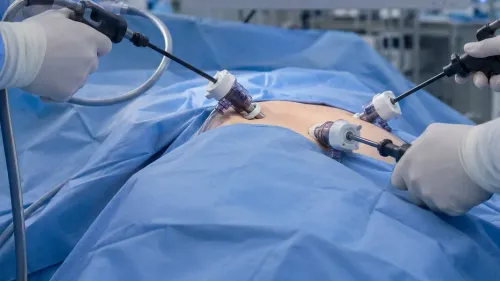
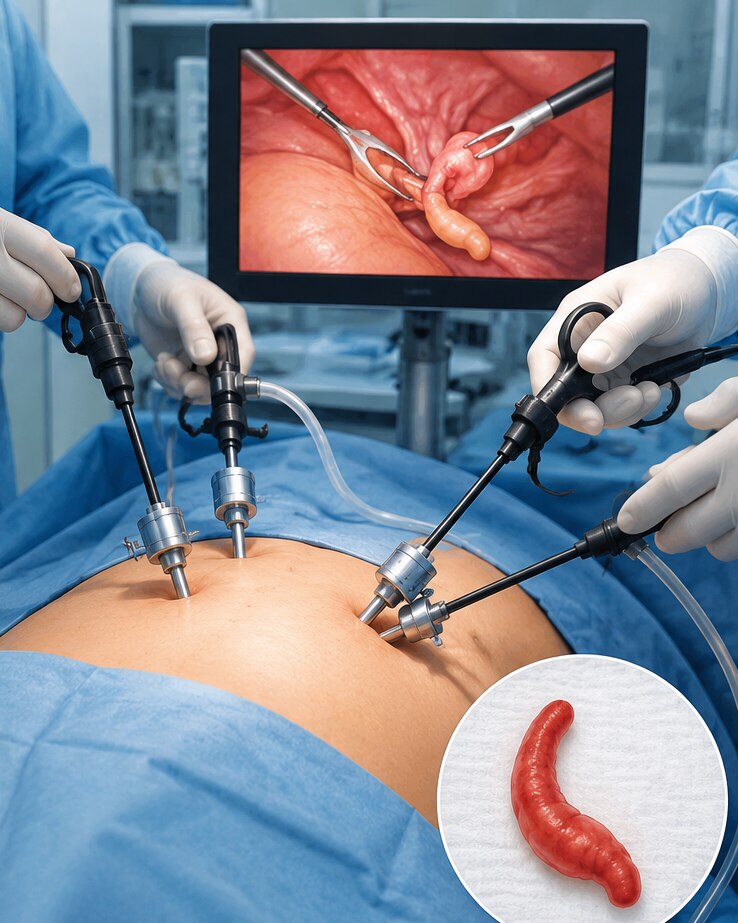
For most patients with uncomplicated appendicitis, laparoscopic appendectomy is appropriate when a trained team, general anaesthesia and suitable equipment are available. It usually means smaller wounds, less pain and a quicker return to normal activity than open appendectomy.
The surgeon makes small cuts, inserts a camera and instruments, separates the appendix from the caecum, seals its blood supply, removes it through a port and closes the wounds. Antibiotics are commonly given before the incision. The removed appendix goes for histopathology, even when it appears straightforward.
| Option | What happens | When it applies |
|---|---|---|
| Laparoscopic appendectomy | Small abdominal incisions, camera-guided appendix removal and wound closure | Uncomplicated disease, or complicated disease when safe access and source control are possible |
| Open appendectomy | One larger incision in the right lower abdomen, followed by direct appendix removal | Severe inflammation, dense adhesions, difficult anatomy or limited laparoscopic access |
| Conversion to open surgery | The operation starts with keyhole access but changes to a larger incision | Uncontrolled bleeding, unclear anatomy, extensive contamination, perforation or an abscess that cannot be safely managed laparoscopically |
Safety takes priority over preserving a small incision. A surgeon can convert to open surgery if inflamed tissues tear, bleeding obscures the view, the appendix is fused to nearby bowel, or cancer is suspected. Generalised peritonitis or deterioration demands prompt source control; an accessible abscess may instead need drainage and antibiotics.
Before surgery, ask Dr Mahesh B Jadhav what findings would trigger conversion, whether an abscess needs drainage, and how the appendix will be examined after removal.
Recovery, antibiotics and follow-up after appendicitis treatment
After an uncomplicated laparoscopic appendectomy, appendectomy recovery usually includes gradually increasing activity, light meals as tolerated and pain control with prescribed medicines. Fatigue and soreness around the small incisions are expected, but pain should improve rather than intensify.
| Treatment | Expected course | Important limitation |
|---|---|---|
| Appendectomy | Usually removes the source; antibiotics often stop after uncomplicated surgery | Complicated infection can require a longer, targeted course |
| Antibiotics alone | Avoids immediate surgery in selected adults; arrange review after discharge | Recurrence, treatment failure and later appendectomy are more likely, especially with an appendicolith |
| Abscess treatment | Drainage and antibiotics may settle infection before reassessment | The appendix can remain at risk of recurrent inflammation |
Antibiotics for appendicitis are not automatically better when continued for weeks. After adequate source control, the surgical team chooses duration according to perforation, abscess, cultures and clinical improvement.
The removed appendix should undergo histopathology of appendix tissue. A neuroendocrine tumour, mucinous neoplasm, endometriosis or inflammatory bowel disease changes follow-up, so ask when the report is available. After successful abscess treatment, an interval appendectomy is an individual decision based on age, recurrence risk and imaging; older adults may need repeat imaging or colon evaluation.
Seek urgent review for increasing abdominal pain, persistent fever, repeated vomiting, fainting, breathing difficulty, inability to pass urine, wound redness or pus, or progressive abdominal distension. These signs can indicate bleeding, ileus, wound infection or an intra-abdominal abscess.
Frequently asked questions
When should abdominal pain receive emergency appendicitis assessment?
Seek emergency care when pain worsens or moves to the right lower abdomen, especially with repeated vomiting, fever, fainting, confusion, inability to keep fluids down, a rigid or swollen abdomen, or severe tenderness.
How do doctors confirm appendicitis?
Doctors assess your symptoms and abdomen, then use blood tests and imaging when needed to support the diagnosis and identify complications.
How does perforated appendicitis change treatment?
A perforated appendix requires urgent treatment because infection can spread inside the abdomen. Care may involve surgery, antibiotics and closer monitoring than uncomplicated appendicitis.
What is the difference between laparoscopic and open appendix surgery?
Laparoscopic surgery removes the appendix through small incisions using a camera. Open surgery uses a larger incision and may be chosen when perforation, extensive infection or other surgical findings make it safer.
What happens after appendix surgery?
Recovery includes monitoring, pain control, fluids, food progression, wound care and antibiotics when prescribed. Follow-up checks healing and identifies problems such as fever, worsening pain, vomiting or wound discharge.